I am a Ph.D. candidate in Electrical & Computer Engineering at the
University of Southern California,
where I completed master's degrees in both Computer Science and Electrical Engineering in May 2025.
My research, advised by
Prof. Rahul Jain
and
Prof. Ashutosh Nayyar,
centers on reinforcement learning (RL), with a particular focus on offline and robust imitation learning,
behavior foundation models, and post-training LLMs. I also collaborate closely with
Prof. Paria Rashidinejad
on RL for LLMs research.
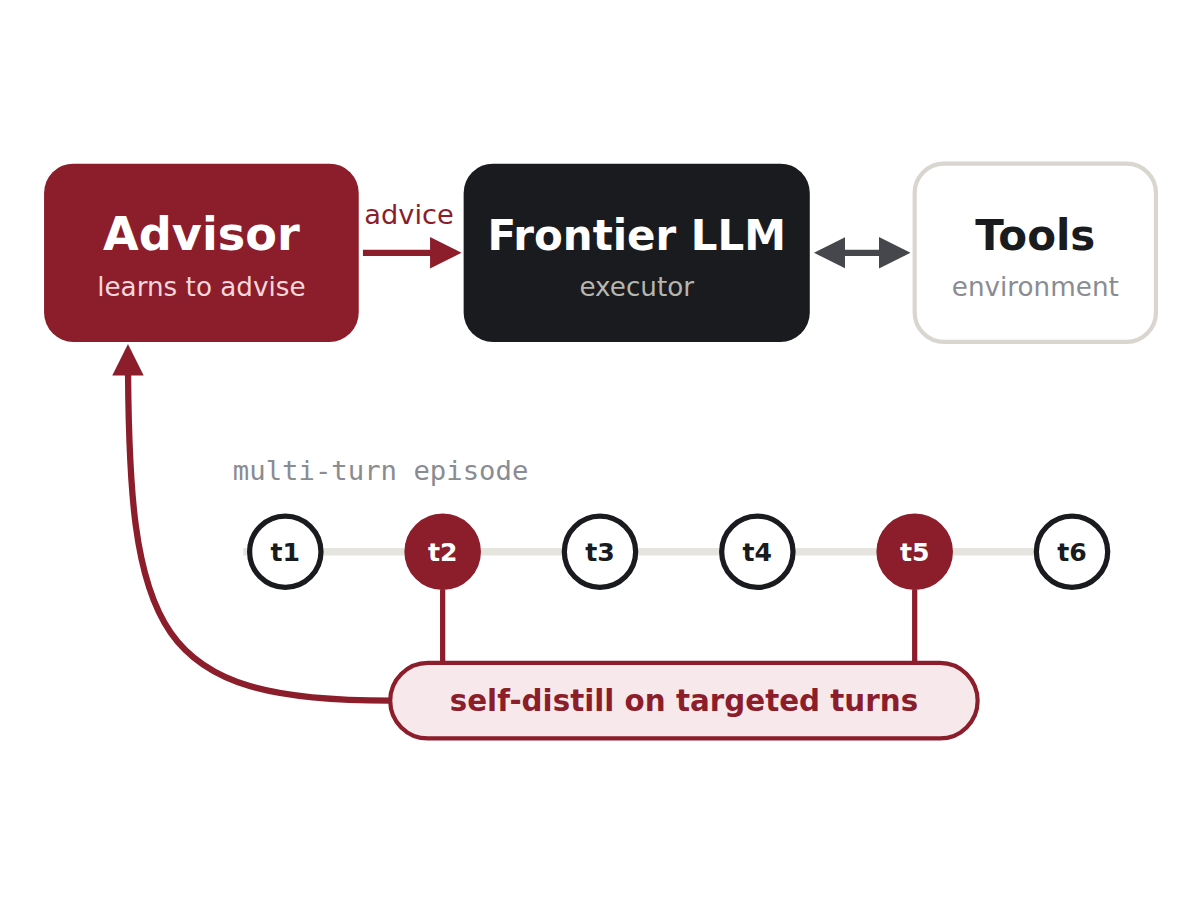
A small trainable advisor can steer a frozen language-model executor using natural-language advice. In addition to learning from task rewards, the advisor can use feedback from completed interactions to improve its advice. However, a plausible correction need not change execution, yet learning from such corrections can still affect the advisor's future decisions in other contexts. In a shared-parameter model, we prove that such corrections can limit learning if their targets favor useful advice less strongly than those of other corrections. Keeping them less often than the rest improves the model's eventual performance compared to learning from every correction. Motivated by this, our method, Advisor Self-Distillation (AdviSD), pairs outcome-based reinforcement learning with self-distillation from a feedback-conditioned copy of the advisor selectively. Reflection proposes corrections, and the advisor scores the same recorded executor response with and without its issued advice, using the magnitude of the difference to select decisions for supervision. This approach does not require executor likelihoods or additional executor rollouts. Experiments with Qwen3-8B advisors for Gemini and Claude show that AdviSD outperforms advisor-GRPO by 4.2–6.4 percentage points on BFCL-v3 and by 3.9–5.1 score points on EnvScaler. The trained advisors generalize to out-of-domain tasks and transfer across different executor versions and model families. AdviSD also beats matched-count random selection, supporting the value of its selection rule.
Reinforcement Learning from Rich Feedback with Distributional DAgger
Rishabh Agrawal, Jacob Fein-Ashley, Paria Rashidinejad
Advances in Neural Information Processing Systems (NeurIPS) 2026
Also accepted at
ICML 2026 Workshop on RL from World Feedback
3rd AI for Math Workshop: Toward Self-Evolving Scientific Agents at ICML 2026
Continual Reinforcement Learning Workshop at RLC 2026
Second Workshop on the Foundations of Post-training at COLT 2026
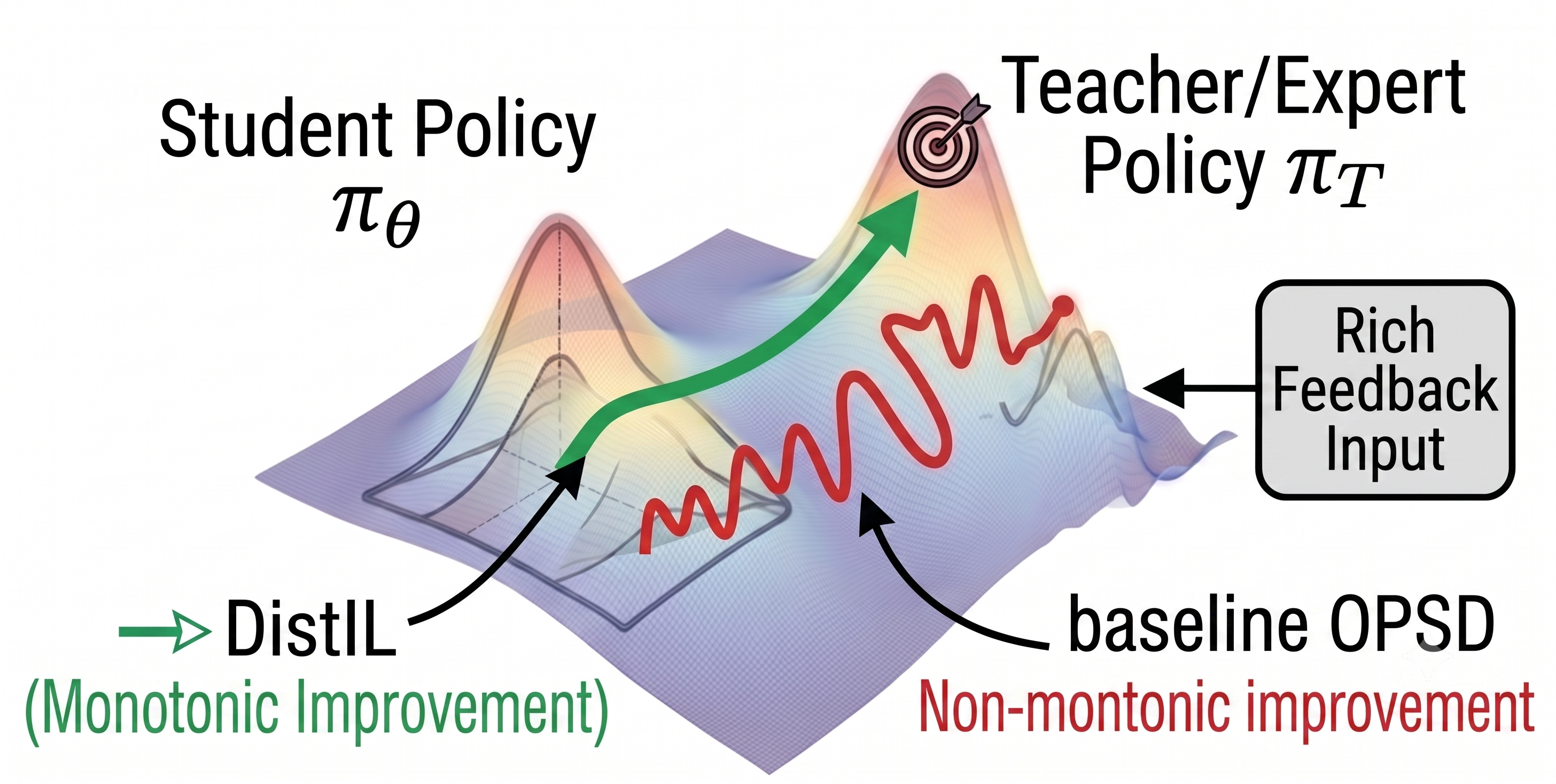
The dominant RL-from-verifiable-rewards recipe rewards each response with a single correctness bit, yet many settings provide far richer feedback — execution traces, tool outputs, expert corrections, self-evaluations. We study how to use such feedback through DistIL, a distributional variant of DAgger that optimizes a forward cross-entropy objective. Unlike reverse-KL or Jensen–Shannon self-distillation, DistIL guarantees monotonic policy improvement and sublinear regret, performs future-aware credit assignment, and improves Pass@N across scientific reasoning, coding, and hard mathematics.
When Dynamics Shift, Robust Task Inference Wins: Offline Imitation Learning with Behavior Foundation Models Revisited
Rishabh Agrawal, Rahul Jain, Ashutosh Nayyar
Advances in Neural Information Processing Systems (NeurIPS) 2026
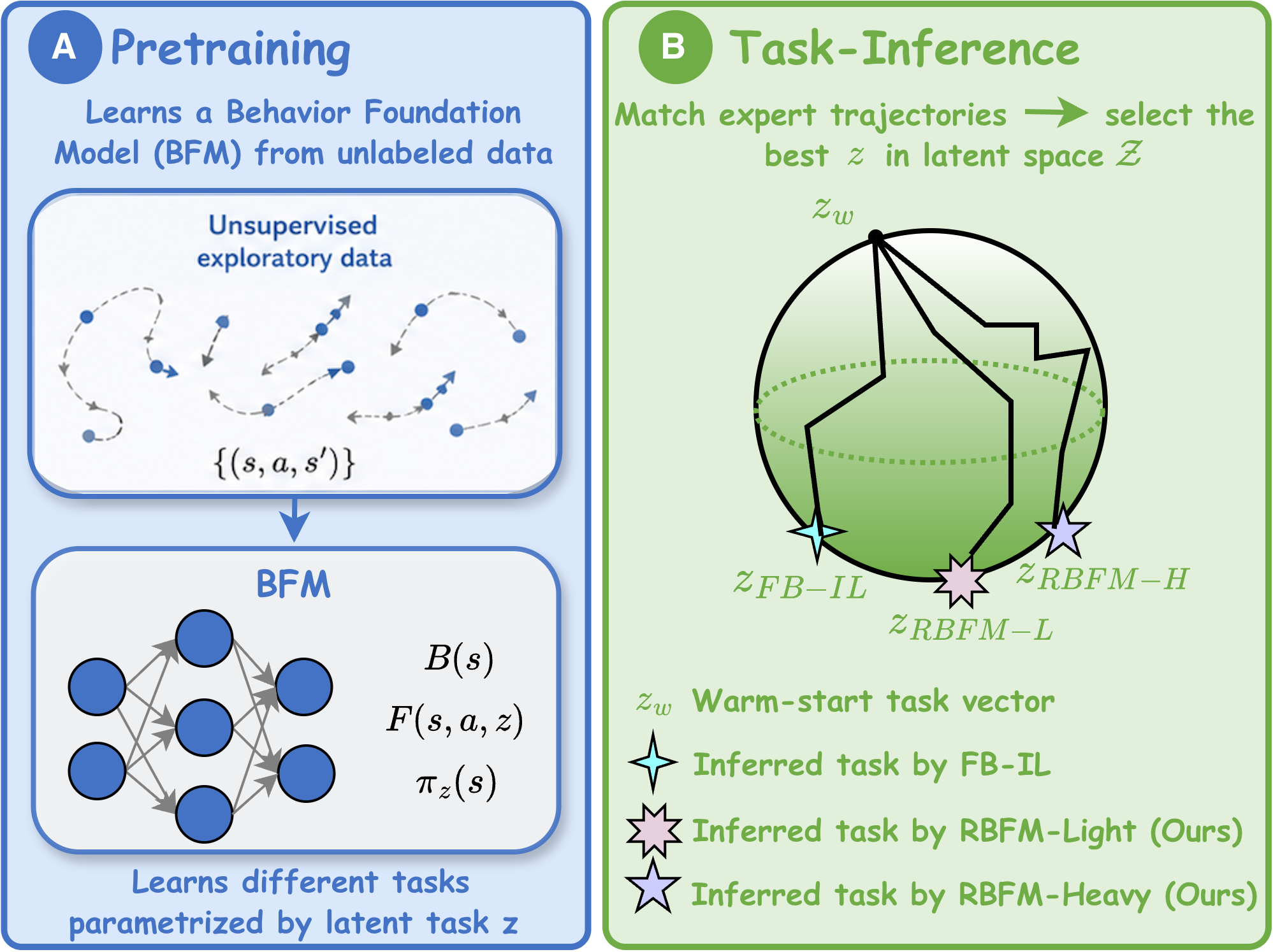
Behavior Foundation Models (BFMs) enable scalable imitation learning but assume fixed dynamics, leaving them brittle to real-world shifts in friction, actuation, or sensor noise. We recast BFM task inference as a robust minimax problem and introduce RBFM-Light and RBFM-Heavy — two variants that add robustness only at inference, with no change to pretraining and using offline data from a single nominal environment. Both substantially outperform standard BFM and robust offline IL baselines under dynamics shifts.
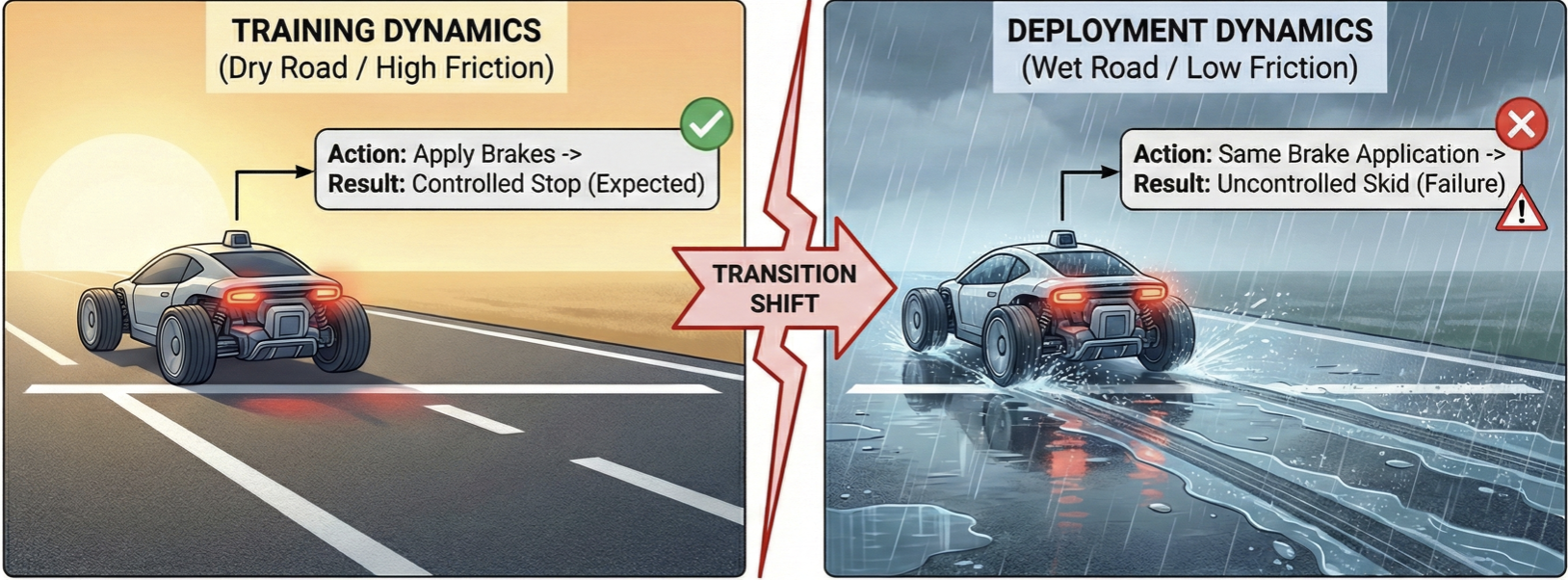
Standard imitation learning implicitly assumes the environment stays fixed between training and deployment — an assumption that rarely holds. We learn robust policies from expert demonstrations alone by solving a distributionally robust optimization over an uncertainty set of transition models, and show the worst-case objective can be rewritten entirely in terms of the nominal data distribution, enabling tractable offline learning with stronger robustness under shifted dynamics.
We study imitation in a strictly offline setting — no environment interaction, no auxiliary data, no transition model. Our method uses the Markov balance equation with a conditional density estimation framework, employing conditional normalizing flows for dynamics, and consistently outperforms many state-of-the-art IL algorithms across Classic Control and MuJoCo.